Media
Videos from our quantum error correction, quantum metrology, and quantum information theory research
Research Talks & Presentations
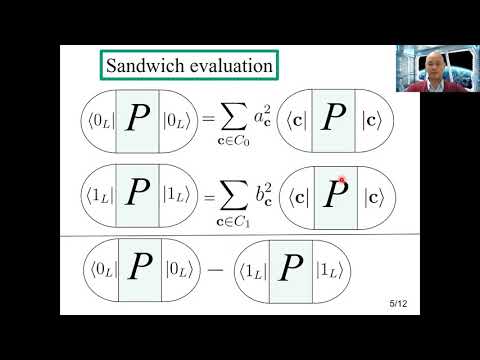
Constructing quantum codes from classical codes
A linear-algebraic procedure of deriving quantum codes from classical codes. Take home: the taste of a sandwich depends mainly on the patty.
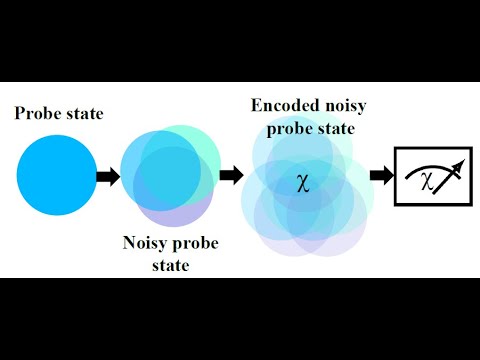
Weight distribution of classical codes influences quantum metrology
If we use a probe state based on a CSS code for field sensing, the precision depends on the weight distribution of the underlying classical codes.
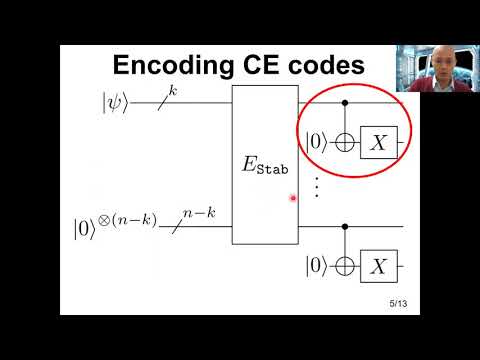
Avoiding coherent errors with constant-excitation codes
Encoding any quantum code with a two-qubit dual rail code allows us to completely avoid coherent errors in a single axis.
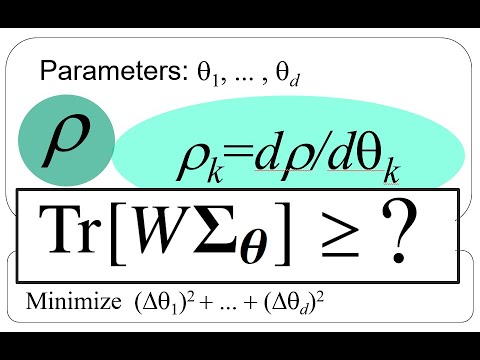
Tight bounds for the Holevo-Cramer-Rao-Bound
A quadratic programming approach to establishing tight bounds for the Holevo-Cramer-Rao bound, with analytical results for the two-parameter case.
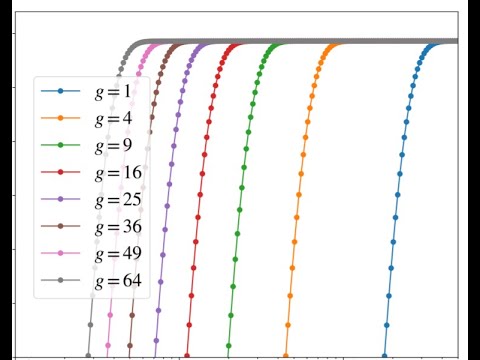
Trade offs on number-shift and phase-shift resilience for bosonic quantum codes
If a multi-mode rotation-invariant bosonic code has in built number-shift resilience, it cannot have too much phase-shift resilience, unless if the number of modes goes to infinity.
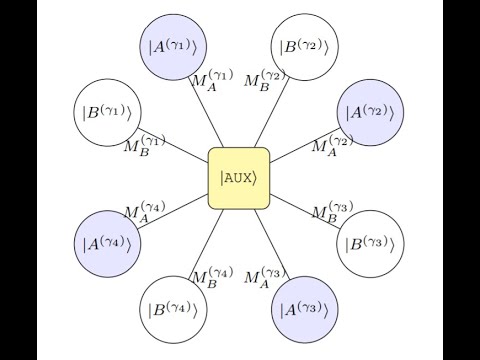
Auxilliary quantum weight enumerators for approximate quantum error correction
We introduce auxiliary quantum weight enumerators to analyze the performance of approximate quantum error correction codes.

What is robust quantum metrology?
A short explanation of robust quantum metrology.
Quantum simulation by Trotterization: merging QDrift and stochastic methods
We get the best of both worlds for quantum simulation by Trotterization by hybridizing QDrift and stochastic methods two different algorithms, obtaining our protocol called SparSto. We prove results on the optimal hybridization of the two algorithms using duality theory in convex programming.
Tight Cramer-Rao Bound for multiparameter quantum estimation theory
We introduce a conic programming framework for bounds in multiparameter quantum estimation theory, establishing a hierachy of bounds from a family of conic programs. The objective function of the conic programs are the same. Only the constraints differ. The cones we consider obey a nested structure thereby giving rise to this hierachy of bounds. The ultimate tight Cramer-Rao bound is the one for non-collective measurement strategies, and we give tight upper and lower bounds for it.
Beyond IID short talk (5min) on trade-offs in number-shift and phase-shift resilience for bosonic codes
If you want lots of number-shift resilience, you cannot have too much phase-shift resilience..
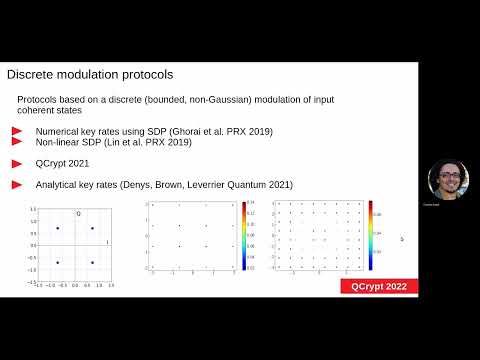
Quantum Key Distribution with non-ideal Heterodyne detection
We give a semi-definite programming approach to analyze the performance of quantum key distribution with non-ideal heterodyne detection.